

Published 23 May 2026 | Updated 1 July 2026 by Jane Robinson
Search flights and hotels
Most UK travellers assume the system is simple: book early and pay less, or wait for a last-minute bargain. Neither rule is reliably true. Understanding why booking windows matter for price is one of the most practical things you can do before spending a penny on flights. The timing of your booking relative to your departure date shapes what airlines charge you, sometimes by hundreds of pounds on the same seat. This article explains how booking windows actually work, what the data shows about price patterns, and how to use that knowledge to spend less on your next trip.Table of Contents
- Key takeaways
- What booking windows are and how they work
- How booking windows affect flight prices
- Nuances that change the picture
- Practical strategies for booking at the right time
- My honest take on booking windows
- Find the best flight deals with Flighttribe
- FAQ
Key takeaways
| Point | Details |
|---|---|
| Booking windows defined | The gap between booking date and travel date directly influences what airlines charge for the same seat. |
| No universal sweet spot | Optimal booking timing varies by route, season, and demand. There is no single rule that works everywhere. |
| Last-minute myths | Peak-season flights rarely get cheaper close to departure. Prices typically rise as seats fill. |
| Route-specific tracking | Monitoring fare trends for your specific route over time is more reliable than following general advice. |
| Combine flight and hotel timing | Pairing smart flight booking windows with flexible accommodation policies reduces both cost and risk. |
What booking windows are and how they work
A booking window is simply the number of days between the date you book and the date you travel. If you book on 1 June for a flight on 15 June, your booking window is 14 days. That gap is not just a number on a calendar. It is a signal airlines read to understand demand, adjust inventory, and set prices accordingly.Airlines do not price seats the way a retailer prices a jumper. Every flight is a small, time-limited market with its own demand curve. Seats are grouped into fare classes, each with a different price and availability threshold. As those classes fill, the system moves buyers into the next, more expensive tier. Booking windows sit at the heart of this process because they tell the airline how quickly demand is building.Here is what that means in practical terms for how pricing behaves across different booking windows:- Very early bookings (6 to 12 months out): Airlines release introductory fares to stimulate early demand. These can be genuinely low, but availability is limited.
- Mid-range windows (6 to 10 weeks out): This is where route-specific pricing tends to settle. For many leisure routes, this is the most reliable window for competitive fares.
- Short windows (under 3 weeks): Remaining seats are priced to capture high-value, less price-sensitive buyers. Business travellers and last-minute bookers pay a premium here.
- Very last-minute (under 72 hours): Prices can drop if a flight is underbooked, but this is the exception, not the rule, particularly during peak periods.
How booking windows affect flight prices
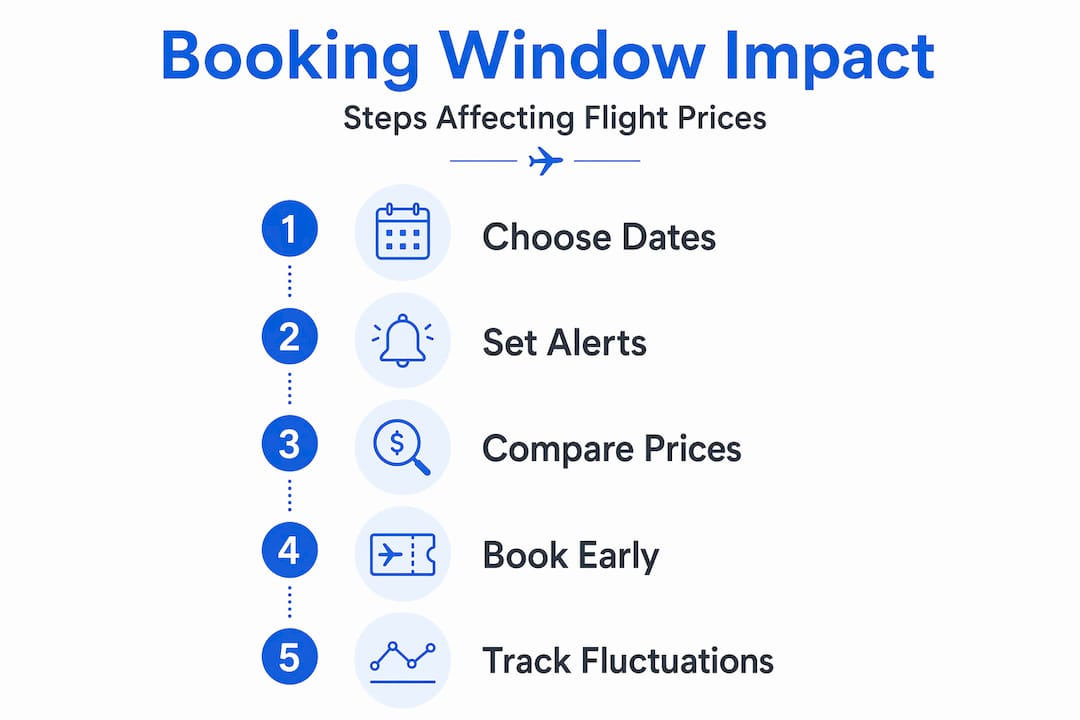 The relationship between booking timing and price is not linear, and that is where most travellers go wrong. Prices do not simply fall as departure approaches. Flight prices during peak periods often increase the closer you get to the travel date, because demand outpaces remaining supply.The table below gives a rough guide to how price variations in booking tend to play out across different scenarios:
| Booking window | Typical price pattern | Best suited to |
|---|---|---|
| 3 to 6 months ahead | Lower introductory fares, good availability | Summer holidays, school breaks |
| 6 to 10 weeks ahead | Competitive mid-range pricing | Most leisure routes |
| 2 to 4 weeks ahead | Prices rising on popular routes | Off-peak or less-travelled routes |
| Under 2 weeks | Premium pricing on busy routes | Flexible travellers, slow-season trips |
 Pro Tip: Set a fare alert the moment you decide on a destination, even if you are not ready to book. Watching prices move over two or three weeks gives you a real baseline for that specific route, which is far more useful than any general rule.Common myths about last-minute booking discounts persist because they occasionally come true. Last-minute deals do exist, but they appear mainly during slow periods when airlines need to shift unsold inventory. Relying on them for a summer family holiday is a gamble with poor odds.
Nuances that change the picture
Understanding the impact of booking timing gets more interesting when you look at the factors that complicate the standard advice. Airlines treat each route as a distinct market with its own demand curve, which means the optimal booking window for a Gatwick to Faro flight may be completely different from Gatwick to New York.A few factors that shift the picture significantly:- Route competition: Heavily competed routes, such as London to Edinburgh or Manchester to Amsterdam, tend to have more stable pricing across booking windows because airlines are watching each other closely.
- Special events: A concert, sporting event, or festival at the destination compresses the booking window dramatically. Prices spike earlier and recover later. If you are travelling to a city hosting a major event, the standard timing advice is largely irrelevant.
- Airline-specific release schedules: Knowing When easyJet Releases Flights or when British Airways typically runs sales gives you a structural advantage. These release patterns create predictable windows of lower pricing that have nothing to do with proximity to departure.
“There is no universal best booking window. Travellers benefit most from tracking route-specific fare trends over time rather than following generic timing rules.” KAYAK Airfare Trends DashboardOne area UK leisure travellers consistently overlook is the interplay between flight and hotel booking windows. Combining flight and hotel flexibility creates budget optimisation opportunities that most people miss. Booking a flight in the optimal window while choosing accommodation with free cancellation gives you the best of both worlds. You lock in the flight price when it is right, and you retain the flexibility to adjust or upgrade your hotel as prices shift.
Practical strategies for booking at the right time
Knowing why booking windows matter for price is useful. Knowing how to act on that knowledge is what actually saves money. Here is a practical approach that works for most UK leisure travellers:- Decide on your destination first, then track fares immediately. Use a fare alert tool to monitor prices from the moment you have a destination and rough dates in mind. Two to three weeks of price data for your specific route is worth more than any general rule.
- Match your booking window to the trip type. For peak-season holidays, school breaks, and popular summer routes, aim to book three to six months ahead. For off-peak city breaks or shoulder-season trips, the six to ten week window often delivers competitive prices without the pressure of booking months in advance.
- Watch for airline sale windows. Understanding British Airways Sale Dates or the timing of the easyJet Big Orange Sale means you can align your booking with structured discount periods rather than hoping prices fall organically.
- Book accommodation with free cancellation alongside your flight. This approach, pairing a committed flight booking with a flexible hotel reservation, reduces financial risk while letting you optimise both costs over time.
- Recognise demand surge signals. If a destination is trending in the news, a major event has just been announced, or school holiday dates are approaching, prices will move faster than usual. Act earlier than you normally would.
My honest take on booking windows
I’ve spent a long time watching how flight prices move, and the single biggest mistake I see UK travellers make is treating booking timing as a trick rather than a discipline. People hear “book early” and do it blindly for every trip, or they hear “wait for last-minute deals” and hold out on a summer holiday until the prices are genuinely painful.What I’ve found actually works is route-specific patience. I track the fare for a specific flight over a few weeks before committing. On a London to Lisbon leisure route in spring, I’ve seen prices sit relatively flat for weeks before jumping sharply at the six-week mark. On a peak-summer Canary Islands flight, I’ve watched prices climb steadily from the moment they went on sale. Those are two completely different strategies, and no single rule covers both.The other thing I’d push back on is the idea that last-minute always means bad value. There are genuine exceptions. A Last-Second All-Inclusive Turkey Deal at a price that undercuts anything available months earlier does occasionally appear. But those deals require flexibility that most families and couples with fixed holiday dates simply do not have. If you can travel at short notice, last-minute can work. If you cannot, do not plan around it.The most pragmatic approach I know is this: book the flight when the price is right for that route, and keep your accommodation flexible until you are certain. It is not glamorous advice. But it is the approach that consistently produces the best outcomes.Find the best flight deals with Flighttribe
Understanding booking windows is only half the work. The other half is having somewhere reliable to spot when prices are genuinely worth acting on. Flighttribe monitors UK flight prices and travel deals continuously, filtering out the noise to surface offers with real value. Whether you are looking for Cheap Flights and UK Travel Deals or trying to time a booking on a specific route, the site gives you the context to make a confident decision. Check the Virgin Atlantic Sale Flights for long-haul options, or browse current budget airline promotions to see what is genuinely competitive right now. The goal is not to push you towards a booking. It is to make sure that when you do book, you are paying a price worth paying.
FAQ
What is a booking window for flights?
A booking window is the number of days between the date you make a booking and your actual travel date. It directly influences the price you pay, as airlines adjust fares based on how demand is building for that specific flight.How far in advance should you book flights in the UK?
For peak-season routes and school holiday periods, booking three to six months ahead typically secures the most competitive prices. For off-peak or shoulder-season travel, the six to ten week window often works well, though this varies by route.Do flight prices drop closer to the departure date?
Not reliably. Last-minute prices tend to fall only when a flight is underbooked during a slow period. On popular routes and during peak seasons, prices generally rise as departure approaches and remaining seats become scarce.Why do prices vary so much between booking dates?
Airlines use dynamic pricing that adjusts fares multiple times daily based on demand signals, seat availability, competitor pricing, and booking pace. The same seat can cost significantly more or less depending on when you search.Is there a best day of the week to book flights?
Research consistently points to midweek searches, particularly Tuesday and Wednesday, as producing lower average fares on many routes. Flexibility on travel dates by even one or two days can also produce meaningful savings on the same booking window.Recommended
- Best time to book easyJet flights: the complete UK guide
- easyJet Big Orange Sale: from £14.99
- When does British Airways have sales? Sale dates 2026
- When does easyJet release flights? (2026 guide)

Jane Robinson is Senior Editor at Flight Tribe. She has a Master’s in English and Journalism, and writes about flight deals, holiday offers and practical ways UK travellers can spend less without wasting time on weak promotions. Jane has spent time living and working across Asia and New Zealand, which gave her a lasting interest in how people travel, eat, move around and spend their free time in different places.
At Flight Tribe, her work focuses on verified prices, realistic travel dates, booking terms and whether a deal is actually worth attention.
How Jane works
Jane checks offers against live supplier pages wherever possible, including prices, dates, departure points, baggage rules and booking conditions. She is quietly sceptical of anything that sounds too good to be true, and helps keep Flight Tribe’s travel advice useful, honest and easy to act on.
Editorial standards
Flight Tribe covers deals for readers first. Affiliate links do not decide whether an offer is worth writing about.